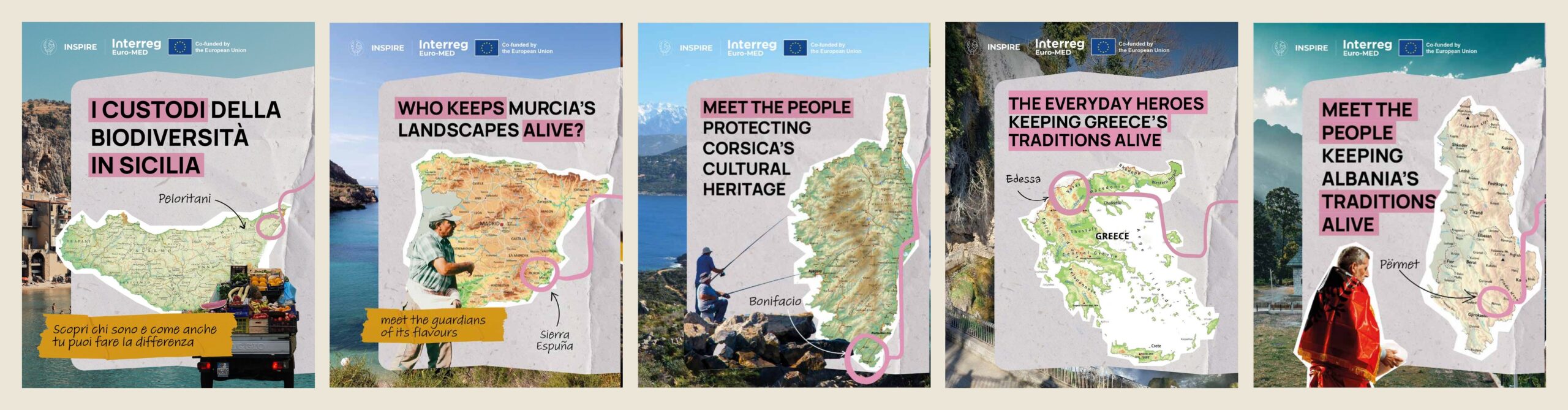
Eight partners from five countries are working together through INSPIRE to put local products, landscapes, and food knowledge at the heart of tourism shaped by the people who live and produce in these places. From the Peloritani Mountains to Sierra Espuña, from Bonifacio to Përmet, this is a story of food and the people behind it.
A lemon growing between sea and mountains, where salty sea air meets cool hillside breezes. A delicate olive oil from a low-yielding variety that is difficult to harvest on rugged terrain. A honey scented with forest or Mediterranean scrub. These are no ordinary products on a shelf: they reflect generations of work and a community’s deep connection to its landscape. This is agrobiodiversity, and it is the foundation of INSPIRE, a project co-financed by the European Union under the Interreg Euro-MED Programme 2021-2027, with the Municipality of Messina as Lead Partner.
What is INSPIRE?
The project’s full name is INtegrating biodiverSity Preservation and agrobIodiversity valorisation In touRism managEment in the MED area. It aims to make protecting and promoting agrobiodiversity part of how Mediterranean tourism destinations are managed. The partnership brings together eight organizations from five countries: the Municipality of Messina as Lead Partner; the Slow Food Foundation ETS as methodological partner; Spain’s Mancomunidad Turística de Sierra Espuña and EuroVértice Consultants; France’s Corsican Tourism Agency; Greece’s Anatoliki S.A. and American Farm School; and Albania’s Ministry of Tourism and Environment.
Agrobiodiversity is more than a list of products
Agrobiodiversity is the variety and variability of living organisms that sustain agricultural ecosystems: from crop species and varieties to livestock breeds and the organisms that support soil fertility and pollination. For Slow Food, whose approach guides the project, safeguarding this diversity also means protecting the knowledge, production practices, food cultures, and relationships through which communities care for their landscapes and food heritage. A cheese, for example, connects pastures and local breeds with cheesemakers, landscapes, and cuisine. INSPIRE applies the Slow Food Travel methodology: it starts by mapping local agrobiodiversity and food heritage with the people who safeguard them, then brings producers, tourism operators, and communities together to co-create experiences. Farmers and food artisans become hosts and storytellers, helping visitors understand the connections between what they taste, how it is produced, and the place it comes from. The project therefore seeks to create not isolated tourism products, but connected experiences rooted in each place.
From place to experience: six steps
How can agrobiodiversity become the starting point for sustainable, experiential tourism? INSPIRE follows six connected steps, moving from understanding a place and its food heritage to developing and testing experiences with local communities.
- Map local agrobiodiversity and food heritage. Field mapping identifies local products, production practices, and the people who keep them alive. It helps establish the themes and priorities that will guide the work, grounding tourism development in the character of each place.
- Bring the community together in a Local Living Lab. A working group of 15 to 25 farmers, livestock breeders, fishers, artisans, restaurateurs, guides, tourism operators, associations, and institutions reviews and validates the mapping findings. The Living Lab creates a space to exchange knowledge and shape the next steps together.
- Define a Local Action Plan. The group turns shared themes and priorities into a practical plan: what will happen locally, who will be involved, and when. This connects the area’s food heritage with a shared direction for sustainable tourism.
- Co-create tourism experiences rooted in place. Producers, tourism operators, and other community members develop experiences together, drawing on the products, landscapes, and knowledge identified through mapping. The aim is to connect visitors with local food cultures and the people behind them, rather than create isolated attractions.
- Develop a sustainable economic model. The next step considers how these experiences can be economically viable for the people who offer them. The challenge is to create local opportunities while respecting the production practices, community life, and landscapes on which the experiences depend.
- Test, learn, and refine. Testing checks whether the experiences work for both visitors and hosts. It is an opportunity to identify what needs adjusting and refine the offer without losing its connection to local agrobiodiversity and community priorities.
The sequence matters: each step builds on the one before. Moving straight from mapping to tourism packages risks creating fragmented experiences, disconnected from local life. INSPIRE instead puts relationships first, so that discovering a place through food also means meeting the people who safeguard its heritage.
Stories from five places: food and people
Every place has stories to tell through its food and the people who grow, gather, make, and cook it. Across these five areas, local products offer a way into the landscapes, knowledge, and everyday lives of the communities who safeguard them.
In the Peloritani Mountains, in the Messina area, the Interdonato Messina PGI Lemon and the Minuta Olive, both Slow Food Presidia, tell a story of food deeply connected to place. That story also belongs to beekeepers, whose work helps maintain the area’s ecological balance, and small-scale winegrowers who care for the landscape. Producers, cooks, farm stays, and small businesses that process local produce form a wider network, keeping food traditions alive. Protecting biodiversity also means sustaining these connections: when the network weakens, the heritage it safeguards becomes more fragile.
In Spain’s Sierra Espuña, Marcona almonds grow alongside the Desmayo and Ramillete varieties, while Murcia PDO paprika and Bullas PDO wine made from Monastrell grapes add their own flavors to the local food story. Citrus, almond, and olive growers are part of this living heritage, as are the families who keep rural recipes such as paparajotes, zarangollo, pipirrana, and michirones alive. Their knowledge connects what grows in the landscape with what is shared at the table.
Around Bonifacio in Corsica, PDO olive oil, PDO Mediterranean scrub honey, and porcu nustrale, the local pig breed used to make prisuttu, coppa, and lonzu, connect food with traditional olive groves, scrubland, and pastures. Olive growers are part of this story, alongside shepherds who carry on the production of cheeses such as Tome Sartenaise and Brocciu, and fishers in coastal communities. Together, these foods and livelihoods reveal the many connections between the landscape and local food culture.
In Greece, between Edessa, Pella and Halkidiki, the story focuses on Edessa cherries and traditional local pepper varieties, such as the Bahovian/Karatzovian pepper, Halkidiki vine leaves and wines, such as Malagouzia and Assyrtiko, and the chestnut and acacia honeys of Pella, as well as the indigenous Greek grape varieties Amassi and Negoska, also found in Pella and deeply rooted in Greek food culture. The people are the farmers of Edessa and Pella, the olive growers of Halkidiki and the producers who keep alive a cuisine of traditional flavours.
Around Përmet in Albania, Bedunica honey—a late-season, single-flower honey—Kaçkavall i Përmetit cheese, and Çaj Mali mountain tea bring the mountain landscape to the table. Their stories are intertwined with those of communities who preserve knowledge of wild plants, small producers of preserves and traditional sauces, and pastoral communities. It is this living knowledge, as much as the foods themselves, that gives the area’s food heritage its character.
What these places share
Common threads run through all five stories. Honey and beekeeping feature in Sicily, Corsica, Greece, and Albania. Olive oil and the landscapes of old olive groves connect the Peloritani Mountains, Sierra Espuña, Corsica, and Halkidiki. Across all five areas, shepherds, small-scale producers, and families pass on recipes and practices. These shared connections allow the project’s communities to learn from one another while preserving what makes each place unique.
Tourism that respects places and people
Without careful management, tourism can turn a place into a showcase and its food into just another commodity. INSPIRE seeks to develop experiences shaped by communities, respecting the rhythms of local life and strengthening their identity. Producers take the lead in telling their stories, rural areas gain new economic opportunities, and food heritage is preserved and passed on. The process will culminate in the INSPIRE Pact for Tourism and Agrobiodiversity, through which institutions will commit to incorporating the project’s results into their policies.
The story continues
Mapping can capture only part of this heritage. Much of it lives in the knowledge of the people who live and work in these places. That is why the INSPIRE Together platform is already available: citizens, producers, and tourism operators can use it to nominate a product that supports biodiversity.
What local product tells the story of your territory and helps safeguard its biodiversity? Share it through the INSPIRE Together platform and help bring your local food heritage to light.
INSPIRE project, Interreg Euro-MED Programme 2021-2027, code Euro-MED0401041, CUP F49I25000250006. Co-financed by the European Union. The Municipality of Messina is Lead Partner.
#InspireTogether, #SlowTourism, and #CommunityInnovation.