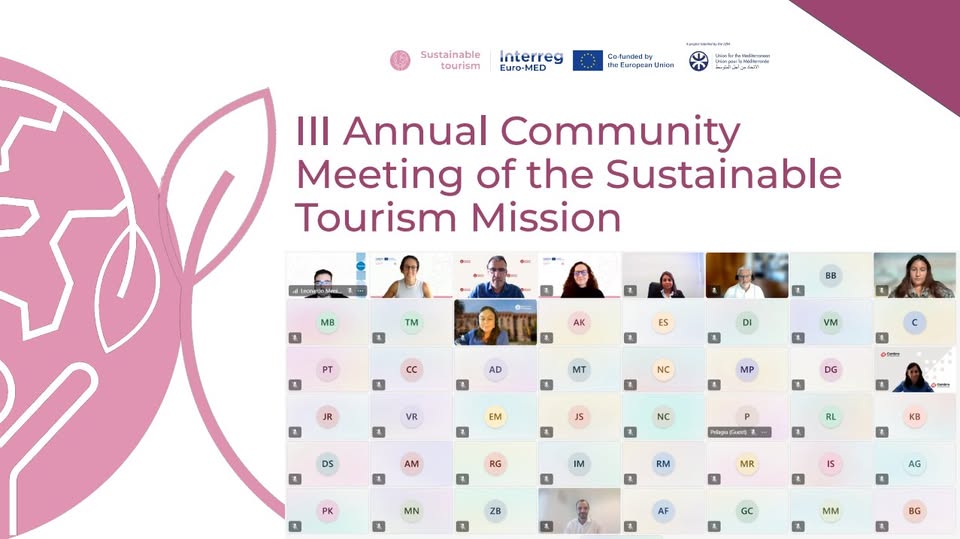

On 16 October 2026, INSPIRE took part online in the III Community Meeting of the Sustainable Tourism Mission of the Interreg Euro-MED Programme, organised by the Community4Tourism project on behalf of the Mission. The Community projects, the governance projects and the Programme’s Joint Secretariat came together to review progress on results, discuss contributions to the Interreg Euro-MED Academy and strengthen synergies between initiatives. For INSPIRE, it was an opportunity to present its method and compare it with those of the other projects in the network.
In the roundtable session, INSPIRE took part in the discussion on a question central to all projects: how to engage stakeholders and ensure they feel ownership of the results. The roundtable, moderated by NECSTouR, also involved the projects GreenSET, WATERISE, TOURISMO and REGENERA4MED. For technical reasons, INSPIRE’s contribution, prepared by the Project Manager of the Municipality of Messina, Dr. Beatrice Briguglio, was submitted to the organisers as a presentation.
The contribution outlined the project, which brings together eight partners from five countries and operates in five pilot territories: Messina, Sierra Espuña, Corsica, Northern Greece and Albania. The Municipality of Messina is the Lead Partner. At the heart of the action are the custodians of agrobiodiversity, namely the producers and food artisans who keep alive a heritage of local varieties, breeds and knowledge. INSPIRE recognises them as protagonists of co-designed tourism experiences and of a destination co-developed and co-managed by public and private actors.
The engagement method was described in four steps. It starts from the territory: already at the public launch conference in Messina in September 2025, local producers and operators were given the floor. This is followed by the mapping of agrobiodiversity, carried out with Slow Food’s methodology, as Slow Food leads the Work Package dedicated to the Living Labs; mapping is also the first moment in which a producer is listened to and brought into a network. The third step consists in convening and selecting the stakeholders able to take part on an ongoing basis. The fourth is co-design in the Living Labs, participatory workshops that feed into the Local Action Plans. Alongside this phase come operator training and the definition of experiential tourism packages, while the American Farm School contributes to the evaluation of the processes.
Five preliminary lessons have emerged from the work so far. Engagement requires adequate margins in the project schedule, because mapping must precede the Living Labs and cannot be compressed. A common methodological framework works when accompanied by continuous training and support in the field. The traceability and reporting rules that are essential with EU funds must be translated into simple forms for participants, who are often small producers. Moving from interest to stable participation requires formal instruments, such as the Local INSPIRE Pact and the INSPIRE Tourism & Agrobiodiversity Pact, both foreseen by the project. Finally, engagement is more effective when it starts from something concrete, such as a variety, a product or a skill.
In the coming months, the project plans a sustainability plan for the Living Labs, to be co-created with stakeholders, and a digital platform for participatory mapping that other territories can replicate. Also planned are five Local Action Plans, a contribution to the Interreg Euro-MED Academy and a final capitalisation event in Corsica. The next in-person meeting of the Community is scheduled for the Interreg Euro-MED Mid-Term Event at the end of November 2026.
#INSPIREproject #SustainableTourism #Mediterranean