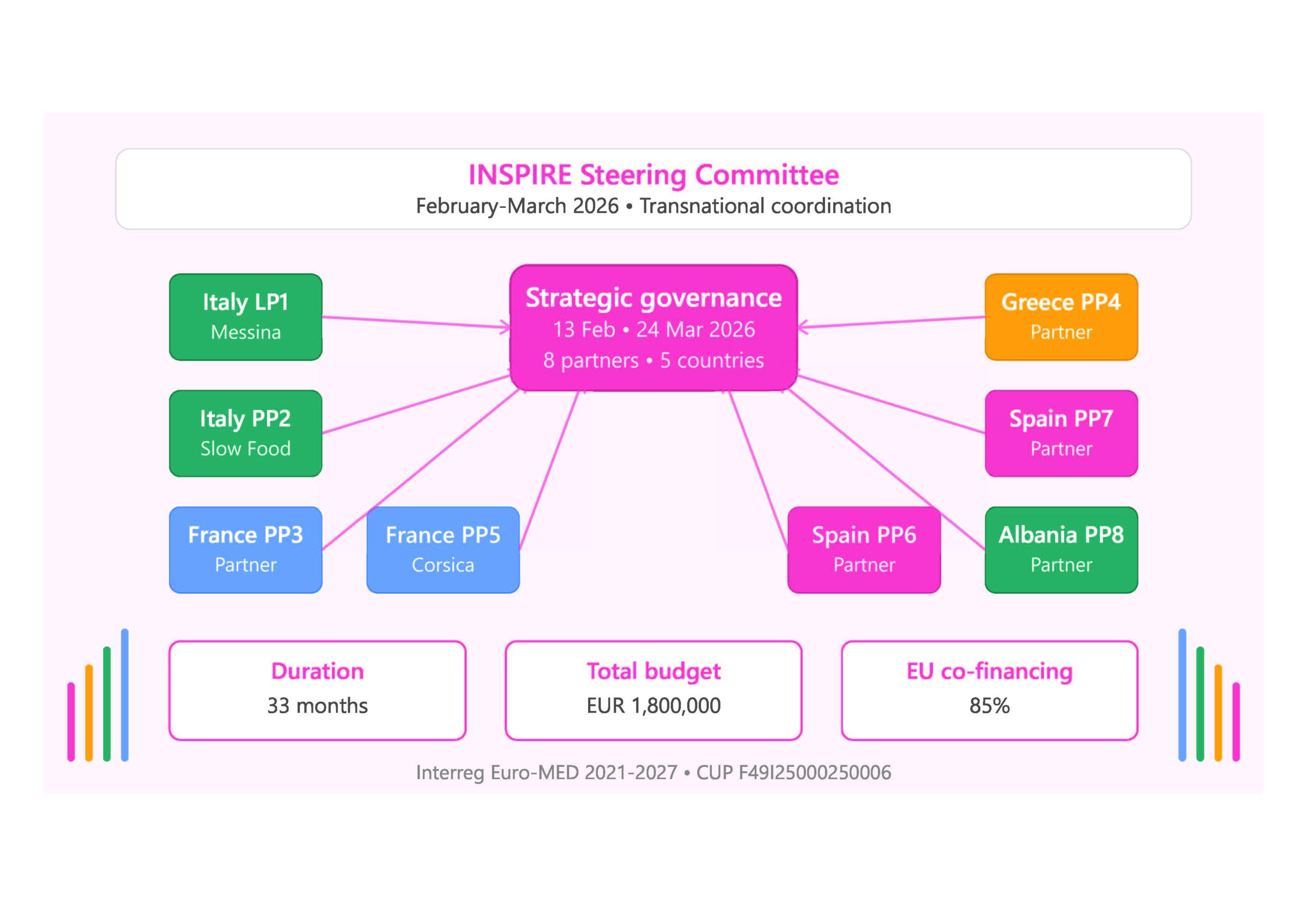

Within the INSPIRE project framework, coordination among transnational partners is a fundamental element to ensure coherence, effectiveness, and quality in the implementation of activities. In this context, Steering Committees play a central role: not merely update meetings, but strategic spaces for dialogue, decision-making, and alignment among the various stakeholders involved.
The meetings held on 13 February and 24 March 2026 brought together the eight partners from Italy, France, Greece, Spain, and Albania, both in person and remotely. This hybrid format successfully combined the benefits of direct interaction—essential for strengthening relationships and fostering dialogue—with the flexibility and inclusiveness offered by digital tools, ensuring broad and continuous participation.
The second meeting, in particular, held strategic importance as it took place just before the closure of the second reporting period, scheduled for 31 March 2026. This made it a crucial opportunity to assess the progress of activities, consolidate achieved results, and address any operational challenges.
Steering Committees therefore serve as key governance moments for the project: they enable an integrated overview of actions across the different territories involved, facilitate the exchange of best practices, and support the definition of future priorities. In a project like INSPIRE, which combines biodiversity conservation with sustainable tourism management in the Mediterranean area, this continuous and structured coordination is essential to ensure a tangible and lasting impact.
Focus on 13 February: Mid-term Review
The February meeting provided an opportunity to analyse the progress of activities during the second year of the project. Particular attention was given to the planning of territorial Living Labs, a core operational tool of the INSPIRE methodology aimed at engaging local communities in mapping agrobiodiversity and co-designing sustainable tourism experiences.
The need to strengthen coordination among partners’ communication activities also emerged, with the goal of maximising the project’s transnational visibility.
24 March: Closure of the Second Reporting Period
The Steering Committee held on 24 March had a more operational focus, concentrating on the final verification of activities completed by 31 March 2026, the deadline for the second reporting period under the Interreg Euro-MED programme.
The meeting also provided an opportunity to plan the next phases of the project, which will conclude in 2027 with a capitalisation event in Corsica and the presentation of the “INSPIRE Pact”, a policy recommendation document aimed at structurally integrating biodiversity into Mediterranean tourism strategies.
Coordination, Perspectives, and Next Steps
The Steering Committees confirm the strategic importance of continuous and structured coordination among partners, a key condition for ensuring coherence in actions across territories and maximising the project’s overall impact. In this context, the sharing of best practices emerging from different geographical areas represents one of the main added values of transnational cooperation: a virtuous process that enables each partner to enhance their approach by learning from others’ experiences.
In the coming months, activities will focus particularly on capitalising on the results achieved and defining strategies to ensure the sustainability of the actions undertaken, even beyond the formal conclusion of the project. This process will be accompanied by preparations for the next in-person meeting, already scheduled in Greece for the first half of May 2026, which will provide a further opportunity for direct exchange and for strengthening collaboration among partners.
INSPIRE is coordinated by the Municipality of Messina and is funded by the Interreg Euro-MED 2021–2027 programme, co-financed by the European Union (CUP F49I25000250006).